
How to Choose the Right Hospital for Knee Replacement
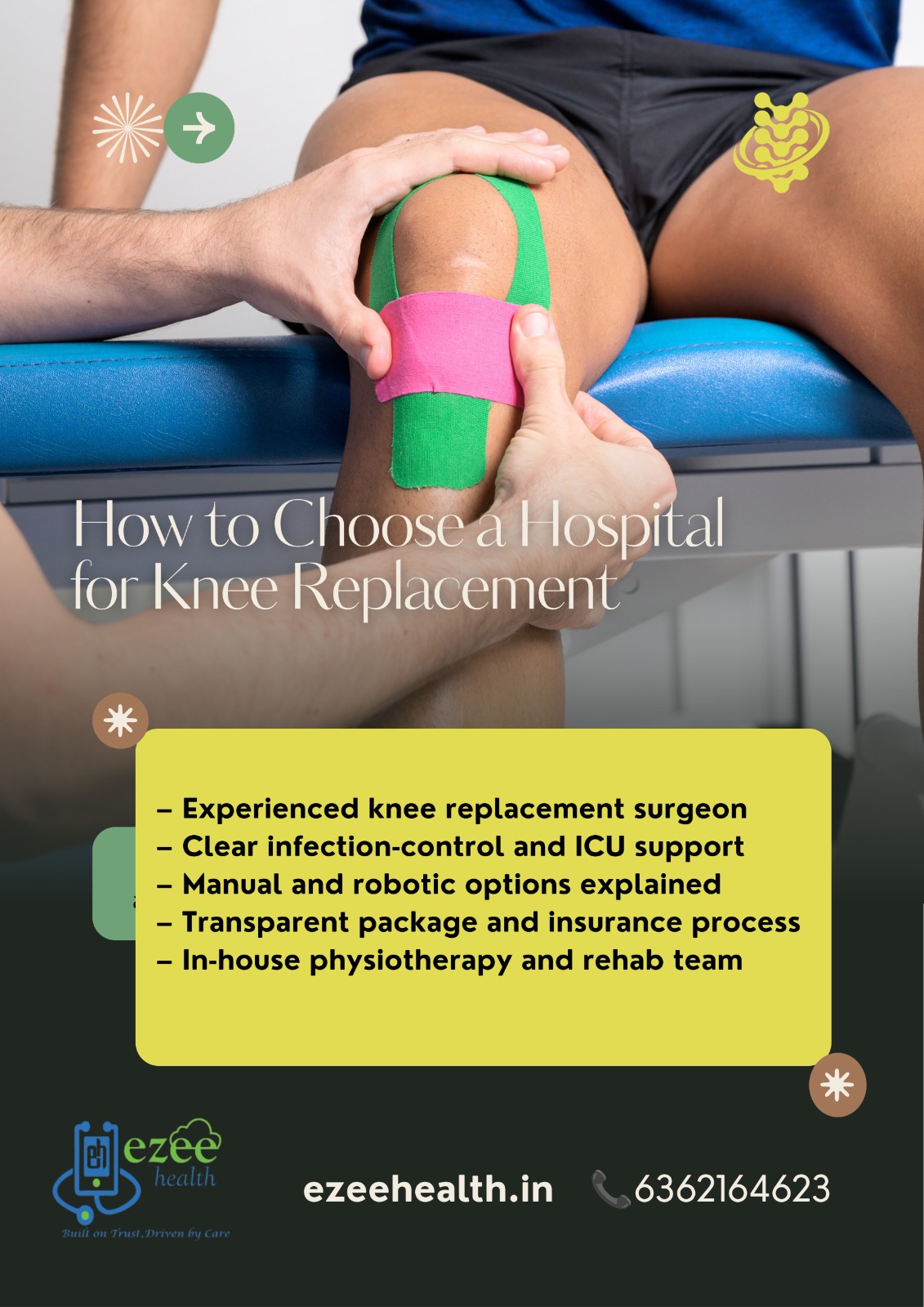
For most families, choosing a hospital for knee replacement is not just a medical decision—it’s an emotional and financial one. You’re trusting a team with the patient’s mobility, independence, and life savings. In India, total knee replacement has a success rate of more than 95% when done in good centres by experienced teams, and most patients regain mobility and significant pain relief. But outcomes can vary a lot from hospital to hospital.
This is where EzeeHealth becomes more than just a name in your search results. Instead of random Google searches and confusing quotations, EzeeHealth helps you compare hospitals in a structured way, co‑manages your case with your local doctor, and keeps your entire journey—from decision to recovery—organized and transparent.
1. Why Choosing the Right Hospital Matters
Knee replacement is one of the most successful orthopedic procedures worldwide, but only when the hospital, surgeon, and systems are strong. High‑quality hospitals tend to have:
- Better surgical outcomes and fewer complications
- Well‑trained nursing and physiotherapy teams
- Clear protocols for infection control and emergency management
In India, knee replacement success rates are above 95% in specialized centres, meaning most patients experience major pain relief and improved mobility. The right hospital doesn’t just operate on your knee—it supports you before, during, and after surgery. EzeeHealth helps you identify such centres instead of choosing blindly based on brand name or advertisements.
2. Check the Orthopedic Surgeon’s Experience
Even in a good hospital, the surgeon matters a lot. You should feel confident about their:
- Case volume – How many knee replacements they perform per year
- Type of cases – Total, partial, complex, or revision surgeries
- Infection and complication rates – Ideally very low, with transparent data
- Training and certifications – Qualifications, fellowships, and areas of specialization Important questions to ask the surgeon:
- How many knee replacement surgeries do you perform each year?
- What are your typical outcomes and complication rates?
- Which implant do you recommend for me and why?
On EzeeHealth, your case is co‑managed by your local doctor and the hospital specialist, so you are not relying only on one person’s word—you get a more balanced, guided view.
3. Manual vs Robotic Surgery Availability
Today, many advanced hospitals in India offer both manual and robotic‑assisted knee replacement. This matters because:
- Robotic systems can help with more precise bone cuts and implant placement in selected patients.
- Manual surgery remains highly effective in experienced hands and may be more
While robotic surgery can sound modern and attractive, it is not automatically “better” for everyone. The key is that your hospital:
- Has both options (where possible)
- Explains clearly why one is recommended for your case
- Shares cost differences upfront
Through EzeeHealth, you can quickly see which partner hospitals offer manual and robotic options, compare them, and discuss the best fit with your local doctor.
4. Hospital Infrastructure & Technology
A good knee replacement hospital is not just about the operation theatre—it’s about the entire ecosystem:
- Dedicated joint replacement unit or orthopedic department
- Modern operation theatres with strict infection control protocols
- ICU and emergency support for high‑risk patients
- In‑house physiotherapy and rehab services
- Digital records and PACS for easy viewing of X‑rays and scans
Strong infrastructure directly supports safer surgery, smoother recovery, and faster discharge. EzeeHealth makes it easier to shortlist hospitals that meet these criteria and match your city/tier (especially for tier‑2 and tier‑3 locations).
5. Understanding Treatment Costs
In India, the cost of knee replacement can vary widely based on city, hospital category, implant type, and whether you are doing single or both knees. Recent estimates show:
- Around ₹1,80,000 to ₹4,50,000 per knee for total knee replacement in many centres
- Around ₹1,50,000 to ₹2,80,000 per knee for partial knee replacement
- Higher costs (often ₹3,50,000 to ₹8,00,000) for bilateral (both knees together) in some hospitals
When comparing hospitals, don’t just look at the package headline. Clarify:
- What exactly is included (OT charges, surgeon fee, implant, room, medicines, tests)?
- What is excluded (ICU stay, extra days, special implants, complications)?
- Are there different packages for general, semi‑private, and private rooms?
EzeeHealth helps you line up these cost details side by side, so you can see where you’re truly saving—not just reacting to the lowest number.
6. Insurance and Cashless Facilities
For many families, insurance and cashless availability can decide where they finally go. Before choosing a hospital, check:
- Is the hospital empaneled with your TPA or insurance company?
- Is cashless treatment possible, or will it be reimbursement only?
- What documents are needed and how long does approval usually take?
Delays and confusion in insurance can increase your hospital stay and stress level. Through EzeeHealth, hospitals and coordinators can help pre‑check eligibility, align documentation, and reduce last‑minute financial surprises.
7. Questions to Ask Before Choosing a Hospital
Prepare a shortlist of hospitals and ask each of them similar questions, such as:
- How many knee replacements are done here in a year?
- Who will be my main surgeon? What is their experience?
- What is your infection rate for knee replacement?
- What implant options do you use?
- How many days of hospital stay are included in the package?
- What is your protocol for pain management and physiotherapy after surgery?
EzeeHealth’s structured approach ensures that you don’t miss these critical questions. Your local doctor can also add case‑specific questions based on your health history.
8. Red Flags to Watch Out For
Some warning signs that a hospital may not be ideal for your knee replacement:
- No clear answer when you ask about surgeon experience or infection rates
- Vague or changing cost estimates with no written breakdown
- Poor hygiene standards or overcrowded wards
- No physiotherapy team clearly involved in the post‑surgery plan
- Pressure tactics (“Book today, or you’ll lose this offer”) instead of calm counselling With EzeeHealth, you get to see multiple hospital options, read patient feedback where available, and avoid being rushed into a decision based on fear, urgency, or sales language
9. How EzeeHealth Helps You Compare Hospitals
This is where EzeeHealth truly stands apart from a simple “hospital search” website. EzeeHealth is a healthcare coordination & co‑management platform that:
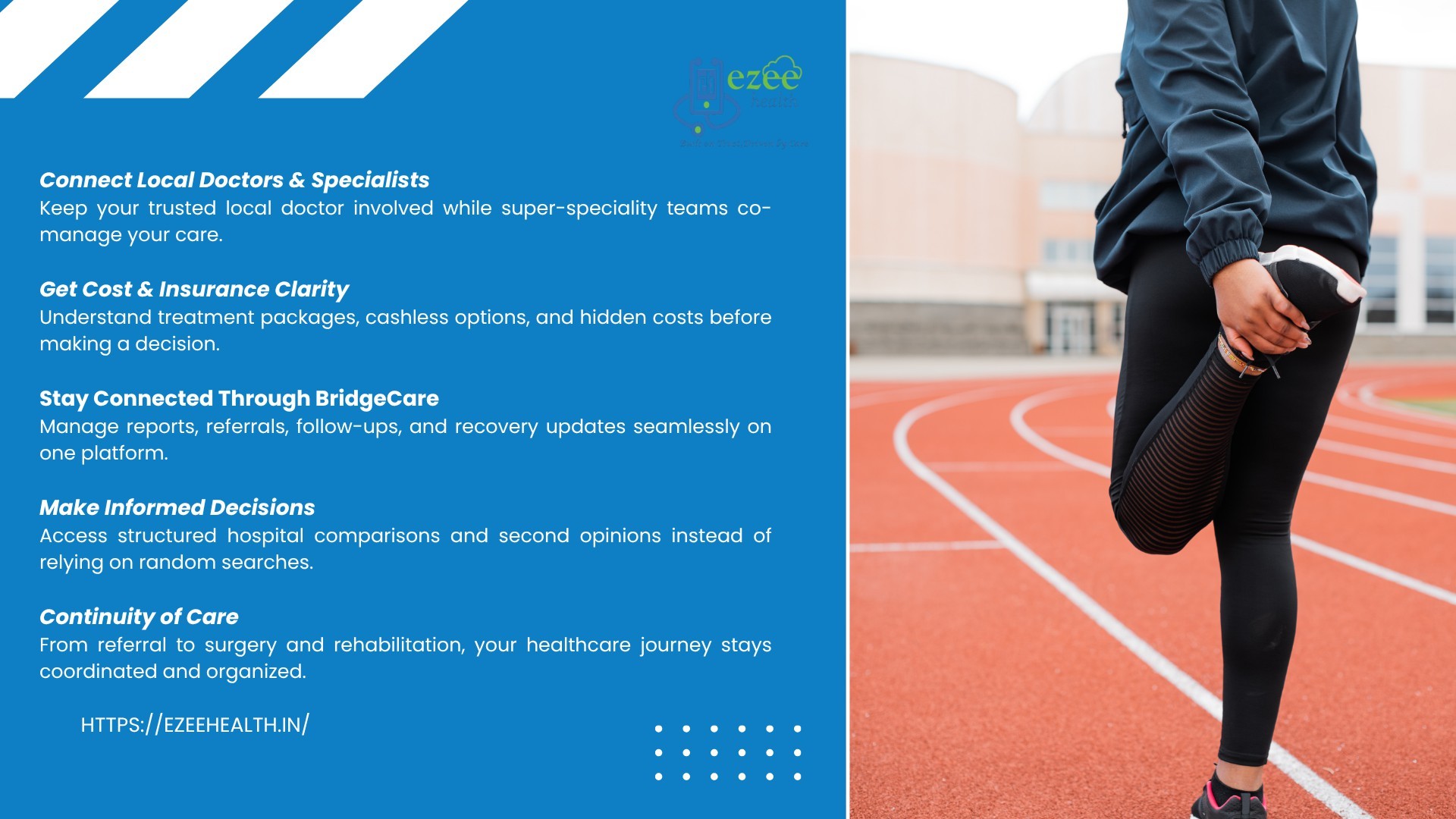
- Connects super‑speciality hospitals with local doctors and patients on one system
- Lets hospitals and local doctors co‑manage the patient’s journey from referral to surgery and follow‑up
- Provides a structured way to compare hospitals on doctor expertise, technology, costs, and facilities
- Uses the EzeeHealth BridgeCare app (listed on Google Play) to keep local doctors actively involved in their patient’s specialty care journey
Instead of random opinions, you get:
- Curated hospital options suitable for your city/tier and case complexity
- The ability to share your existing reports and get aligned recommendations
- A coordinated follow‑up plan so your local doctor remains in the loop even after surgery
10. Real Patient Success Stories
Many patients using platforms like EzeeHealth are not just looking for surgery—they’re looking for clarity and savings. Recent trends from hospital pricing in India show that costs can vary significantly even within the same city. When patients compare and choose wisely, they often end up saving a substantial amount without compromising on quality.
A typical EzeeHealth success pattern looks like this:
- A patient from a tier‑2 or tier‑3 city is referred by their local doctor through EzeeHealth
- Multiple partner hospitals share structured treatment plans and estimated packages
- The patient and family review options, ask questions, and choose a centre that balances quality, technology, and cost
- Throughout surgery and recovery, their local doctor stays connected via the BridgeCare app, ensuring continuity of care